Agencies that sell design, branding or marketing often hit the same wall. A client approves a design, the project needs a solid WordPress build, and your developer is already booked, or you don’t have one. Turning the work down loses revenue, and hiring someone for a single project is slow and expensive.
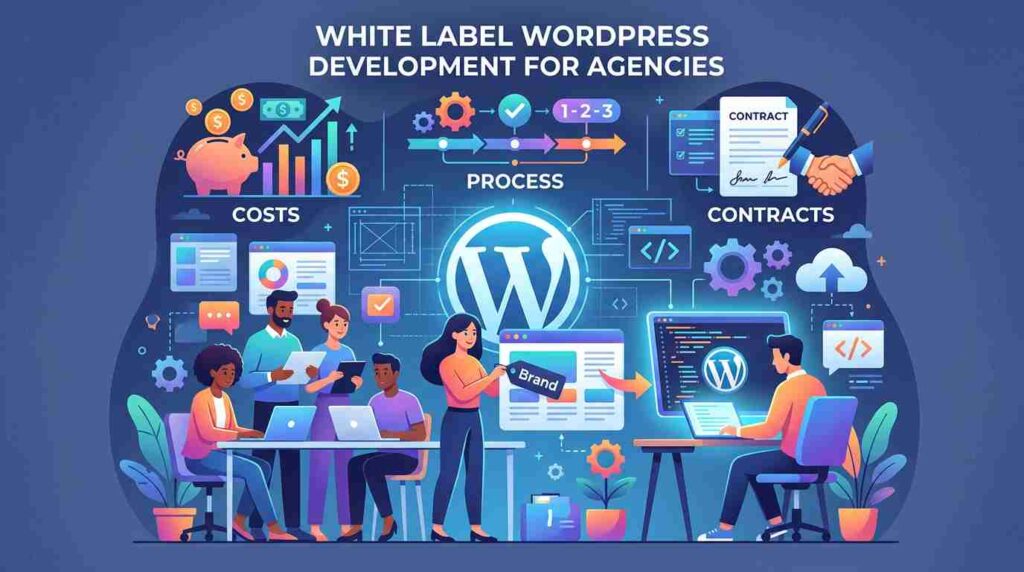
White label WordPress development fixes that by giving you a developer who builds under your brand. This guide covers how it works, what to outsource, what it costs in 2026, how to choose a partner, what the contract should say and when it stops making sense.
What is white label WordPress development?
White label WordPress development is an arrangement where a developer or studio builds WordPress sites that an agency sells under its own brand. The agency keeps the client relationship, the pricing and the credit. The developer works behind the scenes, follows the agency’s process and never markets itself to the agency’s clients.
It suits agencies that need reliable development capacity without adding to payroll. WordPress runs 38.5% of all websites, according to W3Techs usage data in November 2026, so most agencies get WordPress requests whether they planned for them or not. A white label partner lets you say yes to those projects at a cost you know in advance.
How does white label WordPress development work?
A white label project runs like any agency project, with a developer working inside your process. You own the client conversation and the brief, the developer quotes and builds on a staging site, you review and present the work, and the finished site launches under your name with your branding throughout.
A typical project moves through seven steps:
- Send the designs (Figma, Adobe XD or PDF), the page list, the state of the content, any integrations and the deadline.
- The developer comes back with questions and a fixed quote or an hour estimate, priced to your agency.
- Confirm the scope, payment milestones, confidentiality and non-solicitation before work starts.
- The developer builds on a staging site, with the code in a Git repository your agency can access.
- You review the build, present it to your client and pass feedback back within the agreed revision rounds.
- The site goes live with your agency’s name in the theme, notification emails on your domain and no developer credit anywhere.
- You receive logins, code and documentation, and ongoing care continues under your brand on a monthly plan or as needed.
Building on staging matters more in white label work than anywhere else, because your client should only ever see finished, approved changes. If your hosting doesn’t include one, here is how to set up a WordPress staging site.
What WordPress work can an agency outsource?
Almost any hands-on WordPress task can be outsourced: custom themes built from your designs, WooCommerce stores, plugin work, speed fixes, migrations and monthly maintenance. Strategy, design direction and the client relationship are better kept in-house, because they are what clients pay your agency for and what makes your work different.
| Work | Outsource it? | What to hand over |
|---|---|---|
| Design to WordPress builds | Yes, the most common white label job | Final designs, fonts, the page list and content |
| Custom themes and Gutenberg blocks | Yes | Who edits what after launch, and how much layout freedom editors need |
| WooCommerce stores | Yes | Payment, shipping and tax rules, plus the product data |
| Plugins and integrations (CRM, payment, APIs) | Yes | API documentation and test accounts |
| Speed and Core Web Vitals fixes | Yes | Current scores and hosting access |
| Bug fixes and hacked site recovery | Yes, often urgent | Error details, recent changes and backups |
| Maintenance and care plans | Yes, recurring | The list of sites and your update policy |
| Brand strategy, UX research and design direction | Keep in-house | Nothing |
| Client calls and account management | Keep in-house | Nothing, unless you agree otherwise |
How much does white label WordPress development cost?
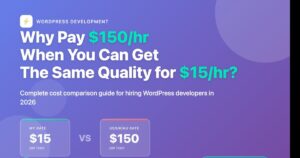
White label WordPress development is usually priced in one of three ways: fixed per project, a monthly block of dedicated hours, or a per-site care plan. Senior developers in India charge about $25 to $60 an hour against $100 to $150 or more in the US, which is where an agency’s margin comes from.
Those rates come from my 2026 WordPress developer rate comparison, which also covers the UK and Australia. The table shows how each pricing model works, with my own published rates as a reference point:
| Pricing model | How it works | Best for | My starting price |
|---|---|---|---|
| Fixed price per project | An itemized quote agreed before work starts | Defined builds with final designs | $900 brochure site, $2,500 custom theme, $4,500 WooCommerce store |
| Dedicated hours | You buy a block of hours each month and assign tasks | Agencies with steady, mixed work | $15 an hour |
| Care plan per site | A monthly fee per client site for updates, backups and monitoring | Maintenance you resell to clients | $49, $129 or $249 a month |
Fixed prices are the easiest to resell, because you can add your margin and quote your client a firm number. Open-ended hourly billing is the hardest, since you carry the risk if the hours run over. Ask for milestone billing that matches your client’s payment schedule so you aren’t funding the build yourself. Full package details are on my pricing page.
Should an agency use a white label partner, a freelancer or an in-house hire?
Use a white label partner when WordPress work comes in waves and you need senior skills without a salary. Hire in-house once you have enough steady development work to keep one developer busy full time. Generic freelance marketplaces suit one-off tasks but rarely suit agencies that need confidentiality and the same developer every time.
| Option | How you pay | Capacity | Main risk |
|---|---|---|---|
| White label partner (solo developer or studio) | Per project, per block of hours or per site each month | Scales with your pipeline | Depending on one outside team |
| In-house developer | Salary, benefits, equipment and idle time | Fixed | Paying for quiet months and being limited to one person’s skills |
| Marketplace freelancers | Per task, plus platform fees | Depends on who is free | A different person each time and uneven quality |
A solo senior developer and a white label studio are both white label partners. A studio gives you more people at once, and a solo developer gives you the same person on every project with direct answers. If you have been hiring task by task on marketplaces, these Upwork alternatives for hiring WordPress developers are worth a look.
How do you choose a white label WordPress partner?
Choose a white label WordPress partner the way you would hire a senior employee: check live work, run a small paid test, read their code, watch how they communicate and get the terms in writing. A partner you cannot see clearly before the first project will be harder to manage once your clients are involved.
- Look at live sites similar to your typical project, and ask which parts they built themselves.
- Pay for a small test task, such as one page built from your design or a bug fix on a real site.
- Have someone technical read the test code. It should follow the WordPress coding standards and avoid a plugin for every small feature.
- Check how they communicate: reply times, written updates, and whether they ask questions before quoting. With a partner in India, plan your US and India working hours so reviews don’t stall.
- Confirm they build on staging with version control and never edit a live client site directly.
- Ask who fixes bugs after launch and for how long.
The same checks work for any outsourced developer. My WordPress developer vetting checklist goes deeper into questions to ask and red flags.
What should a white label WordPress agreement include?
A white label agreement should cover confidentiality, a promise not to contact or solicit your clients, full transfer of code and intellectual property on payment, a clear scope with revision limits, response times for bugs and support, payment milestones, and how the work is handed back if either side ends the arrangement.
| Clause | What it protects |
|---|---|
| Confidentiality | Client names, client data and your pricing stay private |
| Non-solicitation | The developer can’t approach or accept your clients directly for an agreed period |
| Code and IP ownership | Everything built transfers to your agency or your client once paid |
| Scope and revisions | What the price includes, and how extra work gets quoted |
| Support and response times | How fast bugs and emergencies get answered after launch |
| Payment terms | Milestones, invoice timing and currency |
| Accounts and access | Domains, hosting and the main admin account stay with your agency or your client |
| Exit and handover | Logins, code and documentation come back to you if the arrangement ends |
Treat this table as a checklist for the conversation, and have a lawyer in your country review the final contract.
What are the risks of white label WordPress development?
The main risks are poor code quality that your agency has to support, missed deadlines that damage your client relationship, a developer who goes quiet mid-project, and lock-in when only the developer has access to the code. Each one is preventable with a test project, staging, shared access and written terms.
| Risk | Warning sign | How to prevent it |
|---|---|---|
| Poor code quality | A plugin for every small feature, or no answer when you ask how something was built | A paid test task and a code review |
| Missed deadlines | Vague timelines and no milestones | Milestone dates in the contract and weekly written updates |
| Developer goes quiet | Slow replies before you have even signed | A Git repository and staging site you control, so someone else can pick up the work |
| Lock-in | The developer holds the hosting or admin accounts | Keep accounts in your agency’s or client’s name from day one |
| Brand leaks | Developer credits in the footer, theme headers or emails from their domain | White label rules in writing and a check before every launch |
| Client poaching | The developer contacts your client directly | A non-solicitation clause, with all client contact going through you |
When does white label WordPress development stop making sense?
White label stops making sense when you have enough steady WordPress work to keep a full-time developer busy, when development itself is the expertise your agency sells, or when your clients need a developer in the room for workshops and calls. Until then, outsourcing keeps your costs tied to the projects you actually win.
Many agencies settle on a mix: one in-house lead who owns technical decisions and client calls, and a white label partner who handles builds and maintenance when the pipeline is full. That keeps the knowledge of each client inside your agency while your capacity stays flexible.
Can you hire me as a white label WordPress developer?
Yes. I work with agencies as a white label WordPress developer, building and maintaining sites under the agency’s brand. I bring more than 14 years of WordPress work and over 500 delivered projects, a fixed quote for every project, staging on every build and replies in under 5 hours on work days.
For recurring work, my WordPress care plans can run under your brand on every client site you manage. To see how I work before sending anything, read more about why agencies and businesses hire a WordPress developer in India like me. When you’re ready, send me a brief or a small test task and I’ll reply with questions and a fixed quote you can mark up.