
What is a Block Theme?
In a traditional theme, your layout is controlled by PHP files (header.php, footer.php, index.php). In a Block Theme, everything is a block. Your templates are HTML files containing block markup, which are then managed through the Site Editor.
The “Zero-Bloat” Advantage
Classic themes often load large CSS and JS files on every page, even if the features aren’t used. Block themes are smarter: WordPress only loads the styles for the blocks actually present on the page. This is a massive win for your Core Web Vitals scores.
The New Heart of the Theme: theme.json
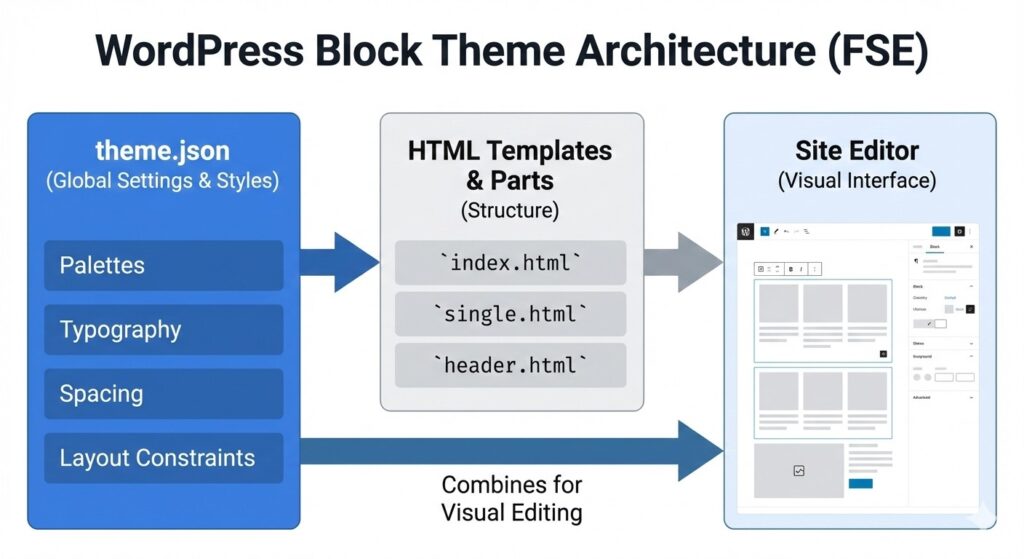
If you learn one thing today, let it be theme.json. This single file has replaced hundreds of lines of CSS and PHP. It acts as the central brain of your theme, defining:
- Global Settings: Color palettes, typography, and spacing.
- Styles: Default appearances for specific blocks (e.g., making all buttons rounded).
- Layout: Content widths and alignment options.
Templates vs. Template Parts
FSE divides your site into two main building blocks:
- Templates: These define the overall layout of a page (e.g., single.html for posts, archive.html for categories).
- Template Parts: These are reusable pieces used inside templates, like your Header and Footer.
Because these are managed in the Site Editor, you can make site-wide changes visually without ever touching a code editor-and without the performance penalty of a heavy page builder like Elementor or Divi.
Comparison: Classic Themes vs. Block Themes (FSE)
| Feature | Classic Themes | Block Themes (FSE) |
| Code Base | PHP & CSS Heavy | HTML & JSON Driven |
| Styling | Style.css / Customizer | theme.json / Global Styles |
| Page Speed | Varies (often bloated) | Ultra-Fast (Modular Loading) |
| SEO Markup | Theme-dependent | Native Semantic HTML |
| Control | Locked by Developer | High Editor Flexibility |
Why Block Themes Win at SEO
- Semantic HTML: Block themes use clean, standardized markup that search engines love.
- Interaction to Next Paint (INP): Because FSE relies on the Interactivity API, your site remains responsive even with complex UI elements.
- No “Div Soup”: Unlike many page builders, FSE doesn’t wrap your content in endless nested <div> tags, making it easier for Googlebot to crawl.
Conclusion: Is it Time to Switch?
If you are starting a project in 2025, a wordpress full site editing guide is your roadmap. Block themes provide the perfect balance of performance, ease of use, and SEO technical excellence.
In our next post, we will look at Post 4: Performance Tuning-How to Get a 100/100 Lighthouse Score on WordPress, where we combine FSE with advanced caching and image optimization.