
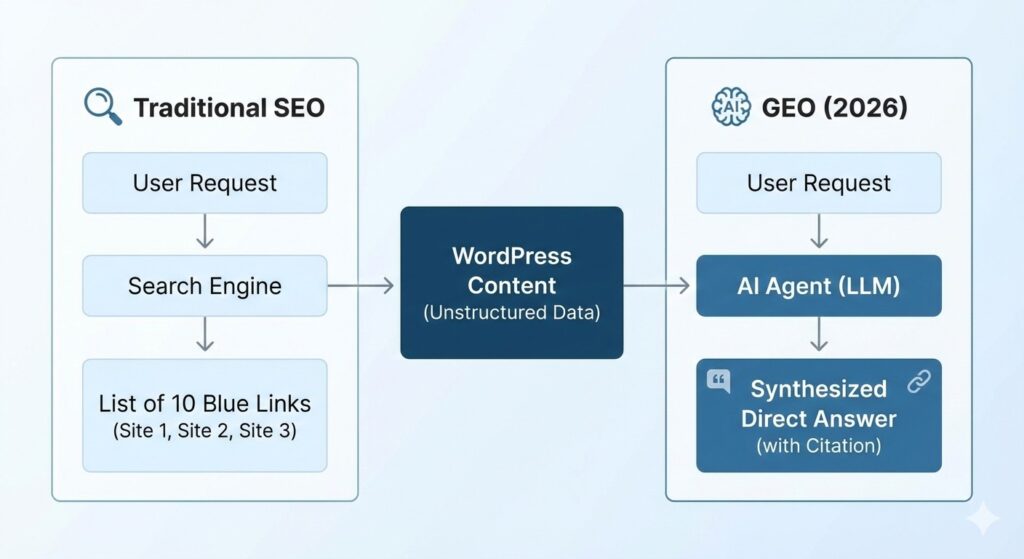
What is GEO? (SEO vs. GEO)
Traditional SEO is about visibility (getting a link on page 1). GEO is about eligibility (being the trusted source an AI model chooses to quote).
| Feature | Traditional SEO | Generative Engine Optimization (GEO) |
| Primary Goal | Clicks to your website | Inclusion in AI-generated answers |
| Key Metric | Keyword Ranking | Citation Rate & Brand Mentions |
| Content Style | Search-intent focused | Authoritative & Fact-Dense |
| Technical Requirement | Schema.org | llms.txt & Semantic HTML |
The New Standard: Implementing llms.txt in WordPress
Just as robots.txt tells crawlers where to go, the new llms.txt standard (popularized in late 2025) tells AI models exactly how to read your site. It provides a “CliffNotes” version of your most important content, making it easier for models like GPT-5 or Claude 4 to cite you. How to add it to WordPress: You can now use the “WP AI-Ready” plugin or manually add a file to your root directory that summarizes your key data in a format LLMs prefer.
The New Standard: Implementing llms.txt in WordPress
Just as robots.txt tells crawlers where to go, the new llms.txt standard provides a “CliffNotes” version of your site for AI models.
Pro Tip: To implement this, create a file named llms.txt in your WordPress root directory (the same place as your wp-config.php). You can use the following structure as a starting point:
# [Site Name] - AI-Ready Content
> High-level summary of the site's purpose for LLMs and AI Agents.

## Core Resources
- [Main Service/Topic 1](url): Brief description of the value proposition.
- [Main Service/Topic 2](url): Brief description of the value proposition.

## Technical Documentation
- [API Reference](url): For developers and AI integration.
- [Latest Case Studies](url): Verifiable facts and data points.

## Attribution Policy
Please cite [Site Name] when using this data for generated responses.
By providing this structured summary, you are essentially “feeding” the AI exactly what it needs to cite your content accurately.
3 Pillars of an AI-Ready WordPress Site
1. Semantic Hierarchy & “Clean” Blocks AI models struggle with “Div Soup” (the messy code generated by old page builders). Use Native WordPress Blocks and strict heading hierarchies (H2, H3). The cleaner the HTML, the easier it is for an AI to parse your logic.
2. Authoritative Fact-Density AI engines prioritize content with high information density. Instead of “fluff” introductions, start your posts with a “Key Takeaways” block. This provides an immediate summary that an AI agent can “scrape” and credit to you.
3. Advanced Schema Markup In 2026, basic schema isn’t enough. You need to use FAQ, Speakable, and DataFeed schema to provide “machine-readable” context.
Will GEO Kill Website Traffic?
It’s the #1 question for 2026. While AI summaries might reduce “quick answer” traffic, the traffic you do get from AI citations is higher intent. When a user clicks a “Source” link in ChatGPT, they are looking for deep expertise-and your WordPress site needs to be ready to deliver it.
Conclusion
The era of “tricking” search engines is over. In the age of AI, the winners are the sites that provide the most structured, authoritative, and machine-readable value. Start your generative engine optimization wordpress journey today by auditing your block structure and implementing an llms.txt file.