
What is RAG? (The 2026 E-commerce Edge)
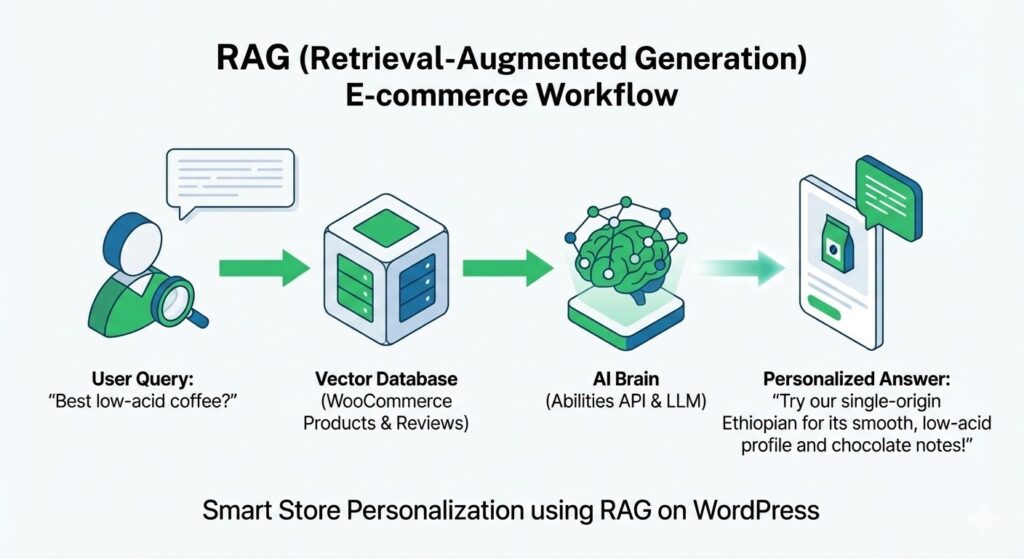
Retrieval-Augmented Generation (RAG) is a framework that allows an AI model to “look up” specific information from your private database (like your product catalog, blog posts, and reviews) before generating an answer.
Instead of an AI guessing what a customer wants based on general training data, a RAG-powered WooCommerce store:
- Retrieves: Finds the most relevant products or technical specs from your site.
- Augments: Adds that specific data to the user’s query.
- Generates: Provides a hyper-personalized recommendation or answer.
This ensures that your AI shopping assistant never “hallucinates” or recommends a product that is out of stock.
Why Traditional Personalization is Dead
Traditional personalization relies on cookies and past purchase history, which are increasingly limited by privacy regulations. ai personalization woocommerce strategies using RAG shift the focus to Intent-Based Search.
- The Old Way: “Users who bought coffee beans also bought filters.”
- The RAG Way: A user asks, “I need a low-acid coffee for a French Press that has chocolate notes.” The RAG system searches your actual product descriptions and reviews to find the perfect match, explaining why it fits their specific palate.
Building the “Semantic Store”: How RAG Works with WordPress
To make this work, your WordPress site needs a Vector Database. Instead of searching for exact keyword matches, a vector search understands the meaning (semantics) behind a query.
The 2026 Workflow:
- Sync: Your WooCommerce products are “embedded” (turned into mathematical vectors) and stored in a database like Pinecone or a local WordPress vector table.
- The Request: When a user types a query or interacts with a “Smart Block,” the Abilities API triggers a retrieval request.
- The Result: The customer gets a natural language response with direct product links that feel curated by a human expert.
3 Ways to Implement RAG in Your Store Today
- Conversational Shopping Assistants: Replace your “Search” bar with a chat interface that can answer complex questions about your inventory.
- Dynamic Product Descriptions: Use RAG to rewrite product descriptions on the fly based on the user’s specific interests (e.g., highlighting “durability” for a contractor vs. “design” for a homeowner).
- Smart Review Summaries: Instead of making users read 100 reviews, have your AI summarize the “Pros and Cons” based on current user sentiment.
The SEO Advantage: Ranking for “Natural Language” Queries
Google’s 2026 algorithms prioritize sites that answer complex, long-tail questions. By using a RAG wordpress guide to structure your content, you are naturally creating the “Fact-Dense” content that Generative Engines love.
When your store provides the best answer to a specific question like “Best waterproof boots for wide feet under $200,” AI search agents are far more likely to cite your product page as the primary source.
Conclusion: The Future is Intent-Driven
Transitioning to an ai personalization woocommerce model isn’t just a technical upgrade-it’s a business necessity. By leveraging RAG and the WordPress Abilities API, you move from being a “catalog” to being a “consultant.”
In our next and final post of the series, we will look at the big picture: AI Agents in the Collaborative Editor-How WordPress 7.0 Changes the Team Workflow.